How to Calculate Class Positions on a Nigerian Report Card (Without Mistakes)
A clear step-by-step guide to working out totals, averages and class positions on Nigerian secondary school report cards including how to handle ties and missing papers.
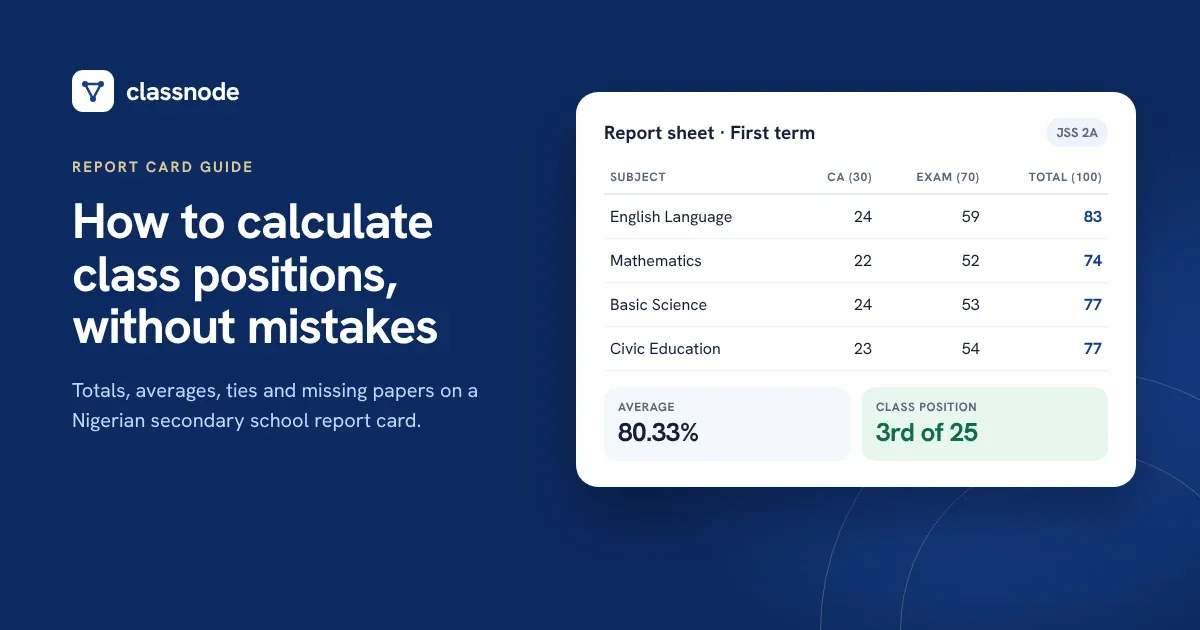
Every term, Nigerian secondary schools face the same high-pressure task: turning stacks of teacher score sheets into accurate report cards with totals, averages and class positions.
It sounds straightforward on paper. In practice, one small error, a miscalculated CA score, a missed subject, or a tie handled differently across two arms of JSS 2 leads to reprinted report cards, tense staff room corrections, and unhappy parents.
Here is a reliable step-by-step process your school can use to get report card calculations right the first time.
1. Calculate each subject's total (out of 100)
Most Nigerian secondary schools split each subject into Continuous Assessment (CA) and the Examination, commonly 30 marks for CA and 70 for the exam (or 40 for CA and 60 for the exam), bringing the total to 100.
If your school splits CA into multiple tests or assignments (for example, CA 1 + CA 2), add those together first, then add the exam score:
- Example: CA 1 (12) + CA 2 (12) + Exam (53) = 77 / 100
Quick check: No student's subject total should ever exceed 100.
2. Add up the student's scores across all subjects
Sum the student's totals across every subject they registered for that term.
- Marks Obtainable: The number of subjects taken multiplied by 100. (For example, 9 subjects × 100 = 900 marks obtainable).
- Marks Obtained: The sum of the student's actual scores across those 9 subjects (for example, 723).
3. Work out the term average (percentage)
To find the student's term average, divide their Marks Obtained by the Number of Subjects Taken (or divide by Marks Obtainable and multiply by 100).
Formula: Term Average = Marks Obtained ÷ Number of Subjects Taken
Example: 723 ÷ 9 subjects = 80.33%
Why average matters more than raw total: In JSS classes, where every student takes the exact same number of subjects, the highest total always equals the highest average. In Senior Secondary (SSS 1–3), however, one student might take 9 subjects while a classmate takes 10. Always use the average to judge performance so students taking an extra elective aren't given an unfair advantage.
4. Rank the class from highest to lowest average
Sort the class list from the highest average down to the lowest:
- The student with the highest average takes 1st position.
- The next takes 2nd position and so on down the list.
5. Decide how to handle ties before results come out
When two or more students finish the term with the exact same average (say, 80.33%), they must share the same position. Where schools often run into trouble is deciding what number comes next.
There are two accepted methods in Nigerian schools:
- Method A (No skipped position: 1st, 1st, 2nd): Two students tie for 1st and the next highest student is placed 2nd.
- Method B (Skipped position: 1st, 1st, 3rd): Two students tie for 1st which uses up the top two spots so that the next student is placed 3rd.
Neither method is wrong. What matters is choosing one rule as school policy and applying it the exact same way across every class and every term.
6. Handle missing papers fairly
If a student missed an exam due to illness or a verified absence, do not record the score as zero (0).
Recording a zero counts that subject as taken, which drags the student's average down and assigns them a class position they didn't actually earn. Instead:
- Mark the paper as missing or incomplete (
–). - Leave that student out of the overall class ranking until the makeup paper is written or calculate their average strictly across the subjects they actually sat for (depending on your school's policy).
- Calculate the overall class average using only students with complete results so missing papers don't skew the class benchmark.
7. Spot-check before you release results
Before printing report cards or publishing results to parents, run a five-minute audit on each class broadsheet. Look out for:
- Subjects left blank or mistakenly entered as
0instead of missing. - Any subject total above
100(usually caused by a typo during CA or exam entry). - Two students with the exact same average showing different class positions.
How Classnode takes the stress out of result week
Doing this manually in notebooks or spreadsheets takes days and one broken formula can throw off an entire class. Classnode handles all of it automatically:
- Instant error-free compilation: Teachers enter CA and exam scores once and Classnode calculates subject totals, term averages, grades and class positions instantly.
- Consistent rules across every class: Ties and missing papers are handled automatically using the exact ranking rule your school chooses.
- Tamper-proof records: Once results are approved and released, they are locked so scores cannot be quietly altered afterward.
- Built for state compliance: Schools in Ogun State can switch on the official Ministry report sheet format in one click complete with affective and psychomotor domain ratings.
Classnode is school management software built specifically for Nigerian secondary schools. Your first term is completely free.